








Industry news


View: 206

Release time:2026-04-21
Grayscale (also called gray level or gray scale) refers to the number of distinct brightness levels a single pixel can display—from the darkest (black) to the brightest (white).
Simple Examples
256 levels → one pixel can show 256 brightness variations
1024 levels → one pixel can show 1,024 variations
4096 levels → one pixel can show 4,096 variations
The higher the number, the finer and smoother the brightness transitions.
A full-color LED display uses three primary colors: Red, Green, and Blue (RGB). Each color has its own grayscale levels.
Total colors = Red × Green × Blue
Example
8-bit grayscale (256 levels per color):
256 × 256 × 256 = 16.7 million colors
This is why higher grayscale directly translates to richer and more realistic color reproduction.
Grayscale is determined by bit depth using this formula:
Grayscale levels = 2^bit
Common Bit Depths
Bit Depth | Grayscale Levels |
8-bit | 256 |
10-bit | 1,024 |
12-bit | 4,096 |
14-bit | 16,384 |
16-bit | 65,536 |
Higher bit depth → more grayscale levels → finer brightness control.
Most modern LED displays use Pulse Width Modulation (PWM) to control grayscale.
How It Works
Instead of changing the LED’s brightness directly, the system rapidly turns the LED on and off. It then adjusts the ratio of “on time” to “off time”:
10% ON / 90% OFF → appears dim
90% ON / 10% OFF → appears bright
Because this switching happens extremely fast, the human eye perceives it as continuous brightness.
Why PWM Matters
High precision control
Stable color performance
Widely adopted across the industry
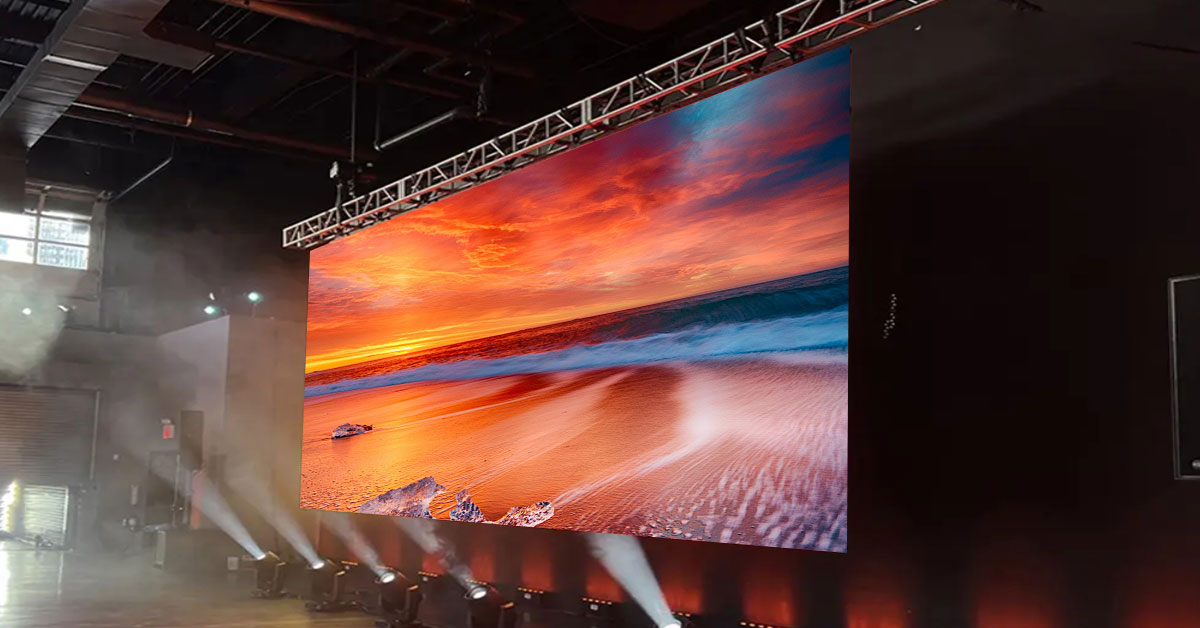
1. Smoother Color Gradients
Low grayscale often causes visible banding (color steps), especially in gradients like skies.
High grayscale ensures seamless transitions without visible jumps.
2. Better Shadow Detail
When you lower screen brightness (common for indoor use), low grayscale can crush dark areas into black.
Higher grayscale preserves subtle details even at low brightness.
3. More Realistic Images
Details like skin tones, shadows, and textures require fine brightness variation.
Higher grayscale captures these nuances, making images look more natural and lifelike.
Grayscale is a critical performance metric for LED displays. If you care about image quality, color accuracy, and visual smoothness, choosing a higher grayscale (and bit depth) display is essential—especially for indoor, close-viewing, or high-end creative applications.
 +86 18688923792
  andy@tosled.com


